



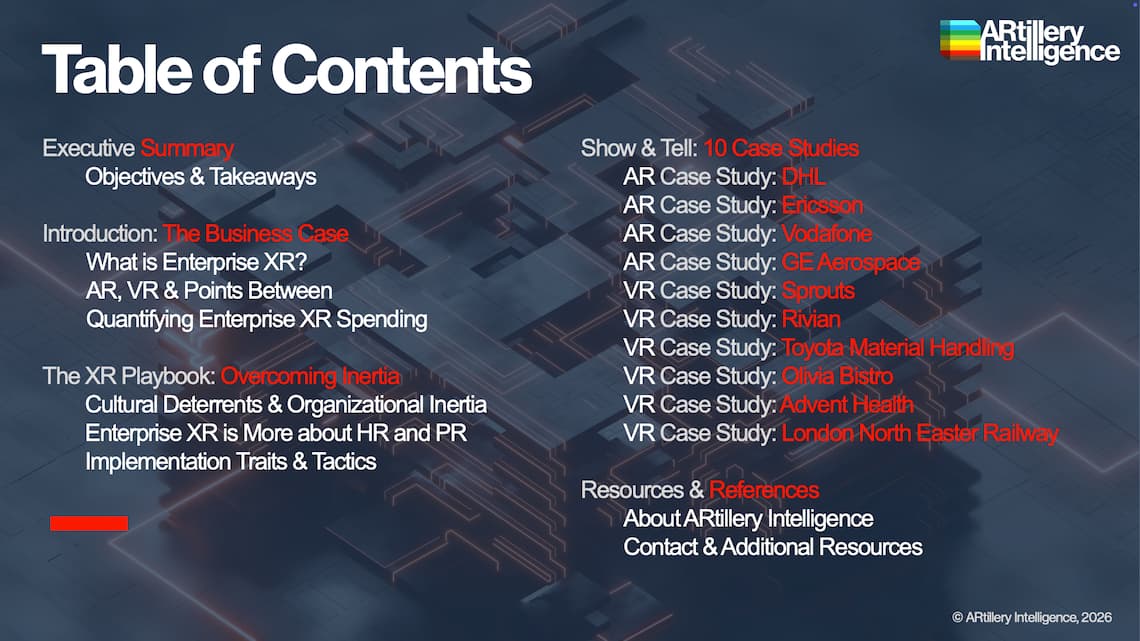
 Executive Summary
Though consumer XR is often a prominent topic, its ubiquity is years or even decades away. This is due to the state of the underlying technology and design challenges in building hardware that’s graphically-robust and stylistically viable. Some XR players sidestep this dilemma with hardware whose UX isn’t reliant on visuals, such as non-display AI glasses.
While that plays out, XR finds fertile ground in the enterprise. Among other things, there’s less stylistic resistance in work settings. More importantly, there’s a clearer business case, such as productivity gains from line-of-sight guidance, or greater efficacy and efficiency in immersive training. These deployments span industrial settings (e.g., manufacturing) as well as corporate environments (e.g., design collaboration).
Use cases include AR visualization to support assembly and maintenance. It can also include visual guidance for IT field support. The idea is that AR’s line-of-sight orientation can make front-line workers more intelligent and empowered. Compared to the mental mapping they do with 2D instructions, visual support boosts effectiveness and safety while lessening cognitive load. And with VR, immersive experiences can boost memory recall and experiential learning in training scenarios across several job types.
In all the above, benefits include speed, accuracy, and safety. These micro- efficiencies add up to bottom-line impact when implemented at scale. Macro benefits meanwhile include lessening job strain and the skills gap, which helps enterprises preserve institutional knowledge.
But it’s not all good news. Though enterprise XR benefits are valid, several roadblocks stand in their way. These include organizational inertia, politics, bureaucratic systems, security concerns, and fear of new technology throughout industrial enterprises.
The result is often the dreaded “pilot purgatory.” As its name suggests, this is when XR is adopted at the pilot stage, but never progresses to full deployment. It’s one of enterprise XR’s biggest pain points. Solutions include communications and change management rather than technology. In other words, sometimes the answer lies more in HR than XR.
With that backdrop, this report continues the ongoing strategic narrative around enterprise XR. This includes original ARtillery Intelligence market-sizing data and insights. Moreover, we devote the bulk of this report to “show rather than tell” through case studies that demonstrate enterprise XR’s ROI and best practices in action.
To adequately represent these factors, we’ve reached out to leading enterprise XR players to collect their top case studies. We’ve then relayed these through our
own lens and analytical rigor. We’ve prioritized case studies that have quantifiable results, actionable takeaways, and a wide range of business verticals.
The goal in all the above is to reveal the why and how of enterprise XR. Through the lens of industry best practices, why should enterprises invest in XR? And how should it be implemented? The name of the game is to set up enterprise XR to succeed by deploying it from a place of confidence and competency.

 Price: $999
The fastest and most cost-efficient way to get access to this report is by subscribing to ARtillery PRO (Startup tier or higher for forecast access). You can also purchase it a la carte.
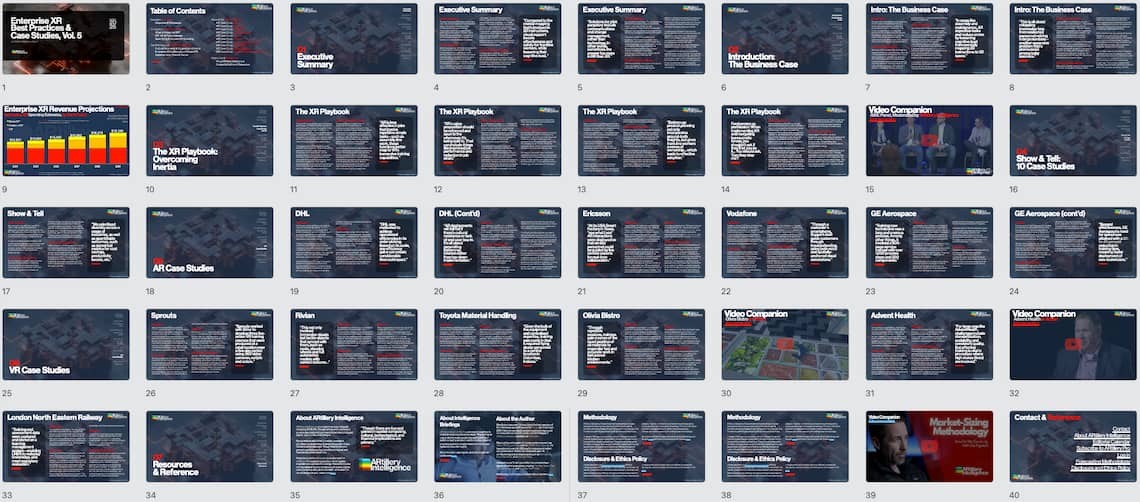
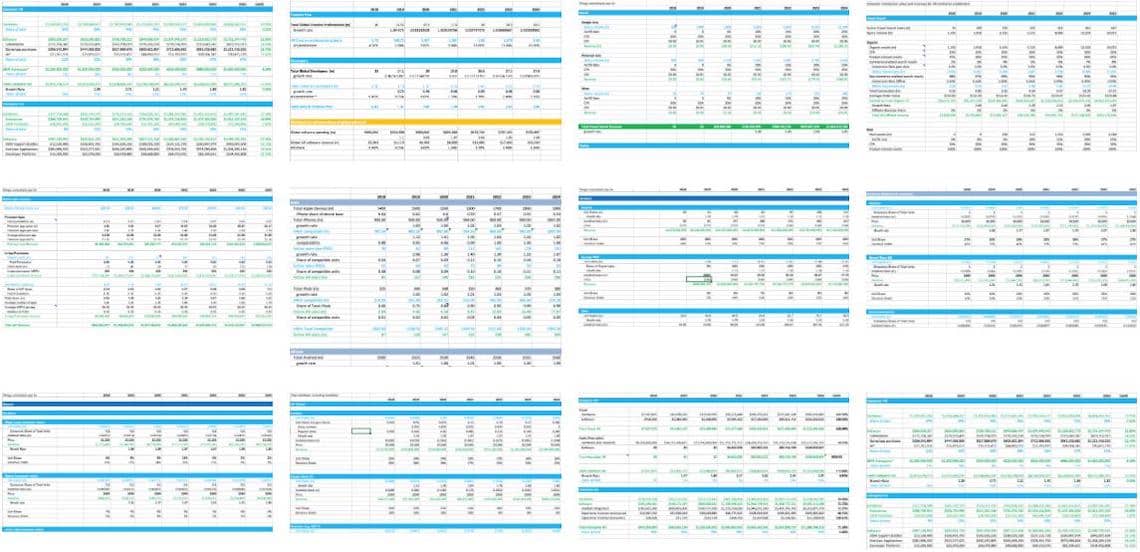
MethodologyARtillery Intelligence follows disciplined best practices in market sizing and forecasting, developed and reinforced through its principles’ 20 years in research and intelligence in tech sectors. This includes the past 10 years covering AR & VR as a primary focus.
This report focuses on revenue projections in various sub-sectors and product areas. ARtillery Intelligence has built financial models that are customized to the specific dynamics and unit economics of each. These include variables like unit sales, company revenues, pricing trends, market trajectory, and several other micro and macro factors that ARtillery Intelligence tracks.
This approach primarily applies a bottom-up forecasting methodology, which is secondarily vetted against a top-down analysis. Together, confidence is achieved through triangulating revenues and projections in a disciplined way. More about ARtillery Intelligence’s market-sizing methodology can be seen here and more on its credentials can be seen here.

 Disclosure & Ethics Statement
Unless specified in its stock ownership disclosures, ARtillery Intelligence has no financial stake in the companies mentioned in its reports. The production of this report likewise wasn’t commissioned. With all market sizing, ARtillery Intelligence remains independent of players and practitioners in the sectors it covers, thus mitigating bias in industry revenue calculations and projections. ARtillery Intelligence’s disclosures, stock ownership, and ethics policy can be seen in full here.
Purchase ReportCheckout easily and securely.
 Questions
Ask us anything
ReferenceCredentials & context