



 Executive Summary
Though VR, AR, and MR – collectively XR – continue to hold great potential, they also face headwinds. Factors holding them back include technological advancement and cultural adoption challenges.
However, bright spots include the rise of AI- powered smart glasses, which have offset declines in other XR subsegments, such as consumer VR. Altogether, it’s a double-edged sword. The positives – mostly orbiting the rise of smart glasses – will outweigh the negatives in the near term.
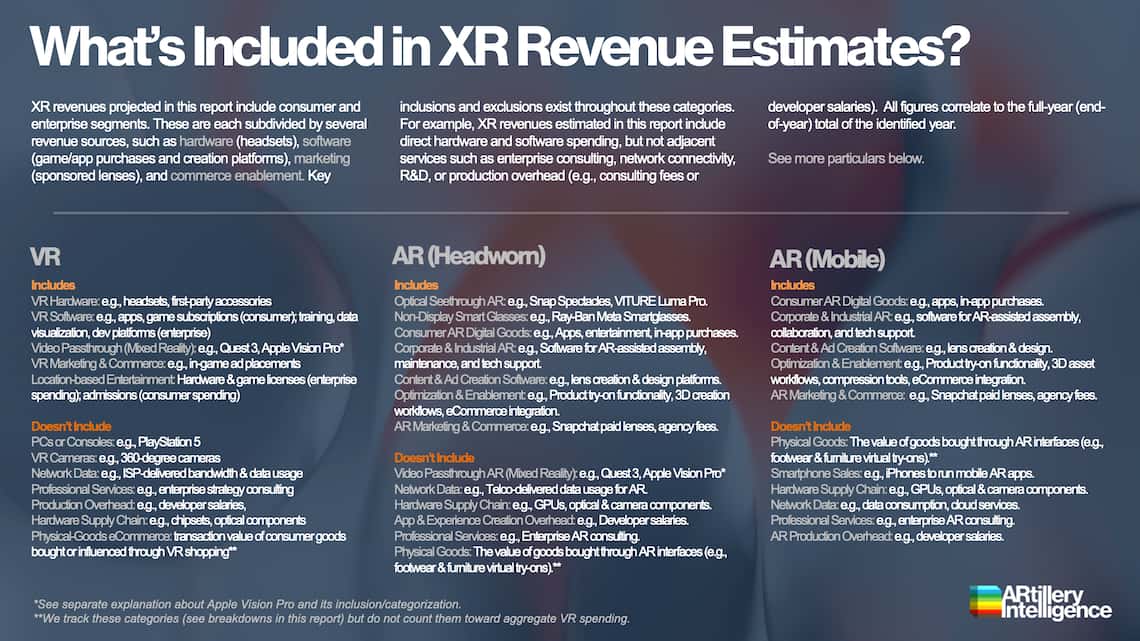
To quantify that claim, XR revenue is projected to grow from $28.8 billion in 2025 to $60.4 billion in 2030, a 15.9 percent compound annual growth rate. VR leads with $14.1 billion in 2025, followed by mobile AR ($9.07 billion) and headworn AR ($5.61 billion). These segments will shift, ending in 2030 with headworn AR in the lead.
What’s driving these subsegments? VR has decelerated in consumer markets but accelerated in the enterprise. The latter is led by immersive training and its ability to breed operational efficiencies and executional efficacy.
Meanwhile, mobile AR scales by piggybacking on 3 billion+ global smartphones. But that usage doesn’t always translate to revenue. Most consumer mobile AR is paid for by enterprises (B2B2C), such as immersive brand marketing. Put another way, most consumer mobile AR is brand-sponsored rather than user-purchased.
The latter was once buoyed by Pokémon Go, which has declined to a degree. But in fairness, there’s momentum elsewhere in user-purchased mobile AR experiences as Snap’s Lens+ premium subscription continues to gain traction.
On to headworn AR, there continues to be anticipation for dimensional AR glasses (see device classes and definitions later in this section). But these bring technological and practical challenges, such as cost and bulk. With the exception of Snap’s consumer Specs and Xreal’s Aura, challenges that face dimensional-AR continue to drive ‘lighter’ approaches.
For example, flat AR is inferior to dimensional AR in its visual UX, but can still be valuable due to utilities such as messaging, POV viewfinders, and other forms of augmentation. These are experientially meaningful, even if graphically underwhelming. And one factor has unlocked their appeal: AI. Situational intelligence brings flat AR from underwhelming to utilitarian.
Meanwhile, similar factors define non-display AI glasses. Led by Ray-Ban Meta Smartglasses (RMS), the toned-down UX noted above is taken to another level by sidestepping visuals altogether. Moreover, this tradeoff of utility and style for visuals has been validated. The market has spoken… to the tune of 10 million+ RMS lifetime units sold. Sales momentum is also strong, while other players have begun to chase these market-validated demand signals.
These challengers include the Android XR ecosystem, which will produce RMS competitors this year. Furthermore, Android XR could do for XR – across device classes – what Android did for the mobile ecosystem 15 years ago.
The bottom line is that after a decade of ups and downs, the XR ecosystem could be facing an inflection, driven by AI-powered smart glasses. The difference this time is that the tech is more stable, and the go-to-market strategies are built on validated demand signals.

 Price: $1,999
The fastest and most cost-efficient way to get access to this report is by subscribing to ARtillery PRO (Startup tier or higher for forecast access). You can also purchase it a la carte.
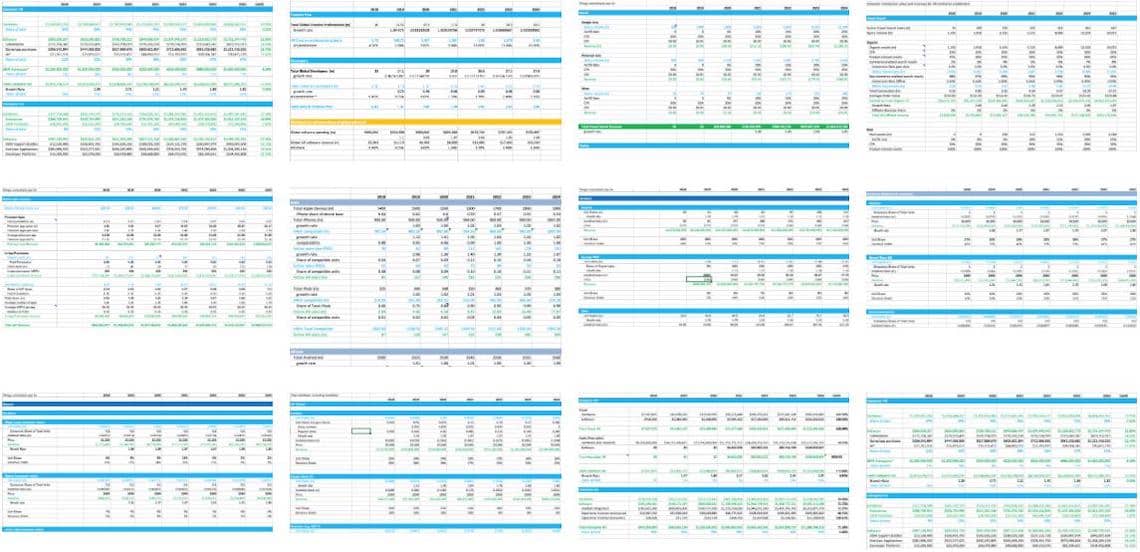
MethodologyARtillery Intelligence follows disciplined best practices in market sizing and forecasting, developed and reinforced through its principles’ 20 years in research and intelligence in tech sectors. This includes the past 10 years covering AR & VR as a primary focus.
This report focuses on revenue projections in various sub-sectors and product areas. ARtillery Intelligence has built financial models that are customized to the specific dynamics and unit economics of each. These include variables like unit sales, company revenues, pricing trends, market trajectory, and several other micro and macro factors that ARtillery Intelligence tracks.
This approach primarily applies a bottom-up forecasting methodology, which is secondarily vetted against a top-down analysis. Together, confidence is achieved through triangulating revenues and projections in a disciplined way. More about ARtillery Intelligence’s market-sizing methodology can be seen here and more on its credentials can be seen here.


 Disclosure & Ethics Statement
Unless specified in its stock ownership disclosures, ARtillery Intelligence has no financial stake in the companies mentioned in its reports. The production of this report likewise wasn’t commissioned. With all market sizing, ARtillery Intelligence remains independent of players and practitioners in the sectors it covers, thus mitigating bias in industry revenue calculations and projections. ARtillery Intelligence’s disclosures, stock ownership, and ethics policy can be seen in full here.
Purchase ReportCheckout easily and securely.
 Questions
Ask us anything
ReferenceCredentials & context